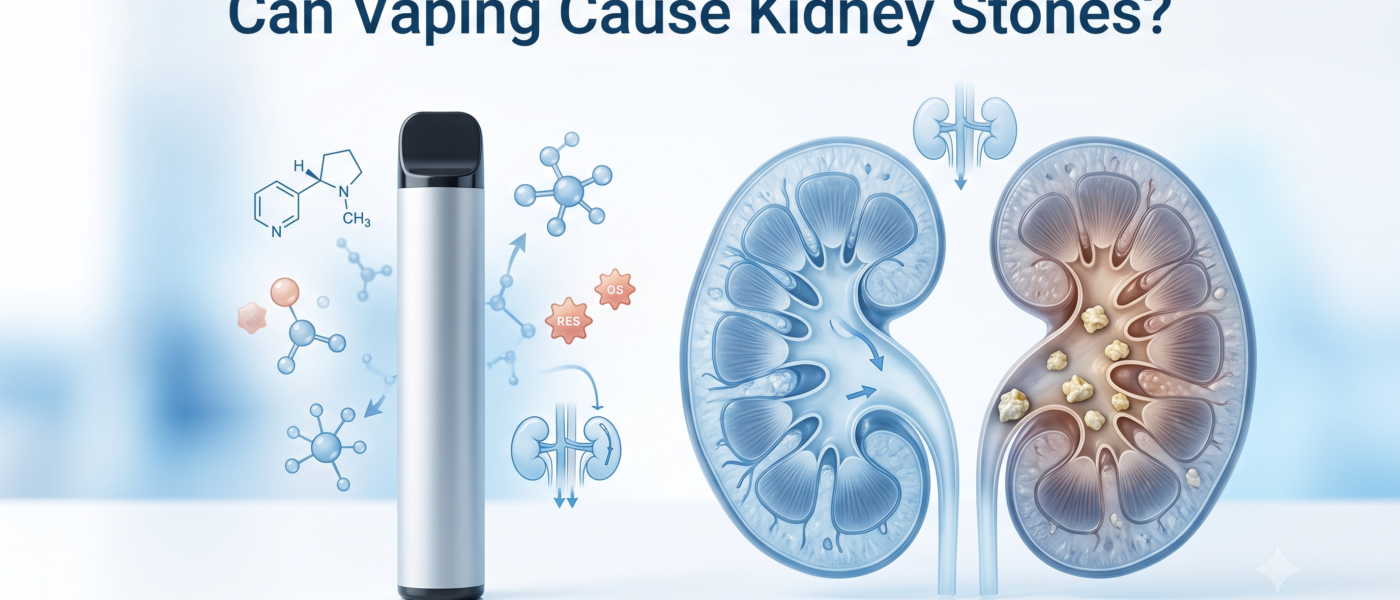
No study has directly measured whether vaping causes kidney stones. What exists instead is a small, contested body of research on how vaping affects kidney function generally, a larger body of research on smoking and stones specifically, and a statistic that gets repeated across vaping-information sites without tracing back to any real source. This article separates those three things, shows the actual numbers behind each one, and states plainly where the evidence is thin.
How Common Are Kidney Stones Anyway?
Before weighing any vaping-specific claim, it helps to know the background rate. Kidney stones are hard deposits, usually made of calcium and other minerals, that form inside the kidney and can cause severe pain if they move into the urinary tract. A 2024 analysis of nearly 38,000 US adults from the National Health and Nutrition Examination Survey (NHANES), a long-running federal health survey, found that about 9.25% of adults, roughly 1 in 11 people, report having had a kidney stone at some point. That rate climbs sharply with age, reaching almost 24% among adults 70 and older, according to a 2024 analysis published in JU Open Plus. Among people with a history of kidney stones in that same dataset, just over half also had high blood pressure and about a quarter had diabetes, both known risk factors independent of anything to do with smoking or vaping.
That is the baseline. Any vaping-specific number needs to be judged against it, not against an assumption that stones are rare.
The Number That Keeps Getting Repeated
Search for this topic and a specific claim shows up again and again on vaping-information sites: that vapers face a 60% higher risk of kidney stones, sometimes attributed to a study in the Journal of Urology. It is a striking number, and it would be worth knowing about if true.
It does not check out. A direct search for that figure, cross-referenced against the most recent systematic review on vaping and kidney health (covered in detail below) and against every other study turned up in this research, found no paper reporting a 60% increase in kidney stone risk tied to vaping. The claim is not in the 2025 systematic review that would be expected to include it if it existed. It is not in the two most relevant NHANES-based studies covered further down. It appears to be a number that has been copied from site to site without anyone tracing it back to a source, which is different from it being proven false. It just means nobody who repeats it can currently point to where it came from.
The closest real, checkable number comes from a 2023 study in Frontiers in Medicine that combined NHANES survey data with a genetic analysis to test cause and effect, not only correlation. Current smokers had 17% higher odds of kidney stones than non-smokers, an odds ratio of 1.17 (95% confidence interval 1.04 to 1.31). An odds ratio compares the likelihood of an outcome between two groups, and a confidence interval indicates the range within which the true value probably falls. People with the highest levels of a nicotine byproduct called cotinine in their blood had 22 to 25% higher odds, with a clear dose-response pattern: more exposure, more risk. When the same researchers tried to establish whether cotinine actually causes kidney stones, using a genetic method called Mendelian randomization, the result was weaker and shakier: just a 9% increase, with a confidence interval (1.00 to 1.19) that barely cleared 1.0, and that only reached statistical significance under one of five analytical methods used.
Two things are worth sitting with. First, that study is about cigarette smoking and a nicotine biomarker common to any nicotine product, not about vaping specifically. Second, even the strongest real number available, for the closest available exposure, is less than half of the 60% figure being passed around. If a claim this specific were real, it should be traceable. It is not.
Two Different Questions, Usually Mixed Together
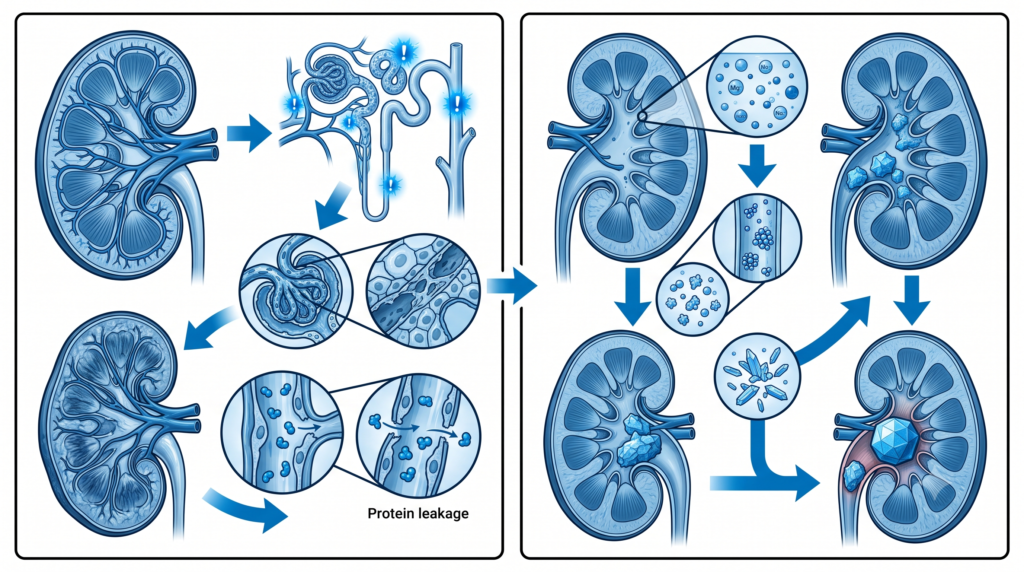
Almost every article on this topic blurs two separate questions: does vaping damage kidney function, and does vaping cause kidney stones specifically. They are related but not the same thing. A kidney can show measurable signs of stress (protein leaking into urine, a declining filtration rate, oxidative damage) without that translating into an actual stone. Stone formation depends on separate factors: how concentrated the urine gets, what minerals are present, and how long they sit before being flushed out. It is one of several organ-specific vaping claims worth checking against the evidence one at a time. PureVapeReviews has run the same kind of check on vaping and tonsil stones, a different condition despite the similar name.
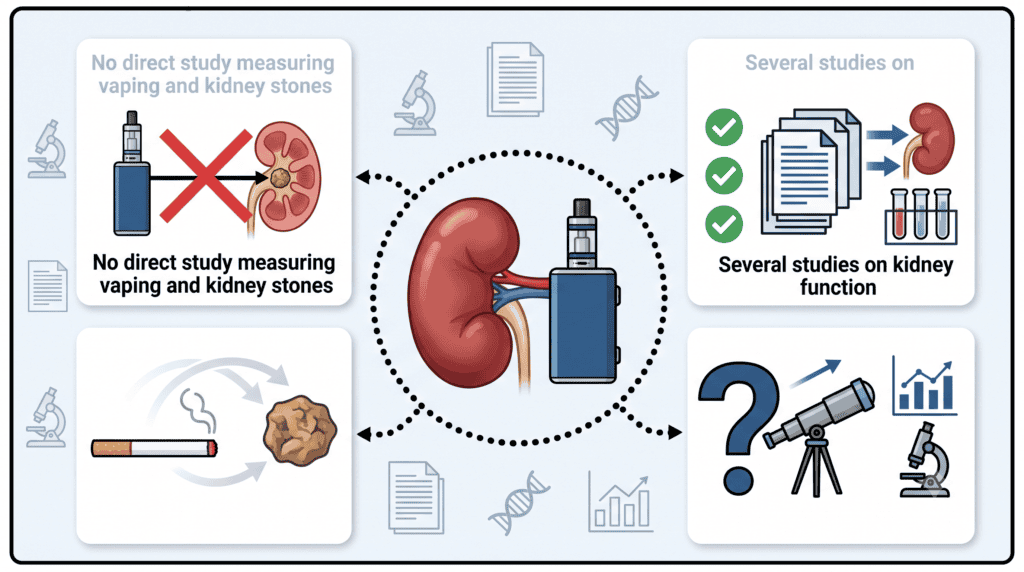
The vaping research that exists is almost entirely about the first question, kidney function. Essentially none of it directly measures the second, stone formation. That gap is the actual state of the science, and it is worth stating plainly. It is also how a 2024 review in International Urology and Nephrology frames the field: knowledge is building, but it is not settled. Most coverage of this topic lets the two blur together instead.
What the Vaping-and-Kidney-Function Research Shows?
A systematic review published in October 2025 in the Brazilian Journal of Nephrology searched three major medical databases and, after screening 354 records down to five studies that met strict inclusion criteria, found a consistent pattern across all five: people who vape show worse kidney-function markers than people who do not smoke or vape at all.
| Study | Sample | What it measured | What it found |
|---|---|---|---|
| Poudel 2024 | 270 people | Albuminuria (protein leaking into urine, a marker of kidney stress) | E-cigarette users: 252.7 mg/day. Cigarette smokers: 106.0 mg/day. Non-smokers: 29.8 mg/day |
| Bragina 2019 | 270 people | Same as above | Similar pattern: e-cigarette users highest, non-smokers lowest |
| Lyytinen 2023 | 22 people, randomized trial | Blood pressure and clotting response after 30 puffs | Nicotine aerosol raised systolic blood pressure by 9.25 mmHg and increased clot-forming activity; nicotine-free aerosol showed no significant effect |
| Sakamaki-Ching 2020 | 53 people | Oxidative stress markers in urine | Markers of cell damage from oxidative stress were elevated in e-cigarette users versus non-smokers, along with metal exposure markers |
| Daisy 2024 | 1,315 people | Cotinine (nicotine exposure marker) | Nicotine e-cigarette users: 61.3 ng/mg. Non-users: 0.4 ng/mg, confirming a dose-response relationship with frequency of use |
Two animal studies add mechanistic detail the human studies cannot provide. In one 2017 study in the FASEB Journal, mice exposed to nicotine-containing vapor for six months, alongside a normal diet, showed a measurable drop in kidney filtration rate and increased scarring of kidney tissue. A separate study, published in Nutrients in 2023, combined nicotine vapor exposure with a high-fat diet in mice and found increased oxidative stress, DNA damage, and early markers of kidney scarring.
The review’s own conclusion stays measured, not alarmed: the findings suggest vaping’s effects on kidney function “may be similar to those of conventional cigarettes,” but the authors are explicit that “definitive conclusions on the harm of e-cigarette use to kidneys cannot be currently drawn.” A major complicating factor they name directly: between 40% and 60% of adult e-cigarette users also smoke conventional cigarettes, which makes it hard to isolate vaping’s effect from smoking’s in any of these studies.
Kidney function is far from the only organ system this kind of claim gets made about. PureVapeReviews has checked similarly specific claims elsewhere, including whether vaping causes anemia and whether it causes constipation, applying the same standard: check what has actually been measured before repeating a claim.
A Contradiction Nobody Has Resolved
The single largest and most direct study on vaping and chronic kidney disease produced a striking result, and then a follow-up study using the same public data took that result apart.
In a study published in BMC Public Health in August 2025, a team analyzing 2017 to 2020 NHANES data reported that e-cigarette users had 2.5 times the odds of chronic kidney disease compared to non-users, with a clear dose-response relationship: heavier use, higher odds. It was a striking finding, and one that would matter a great deal if it held up.
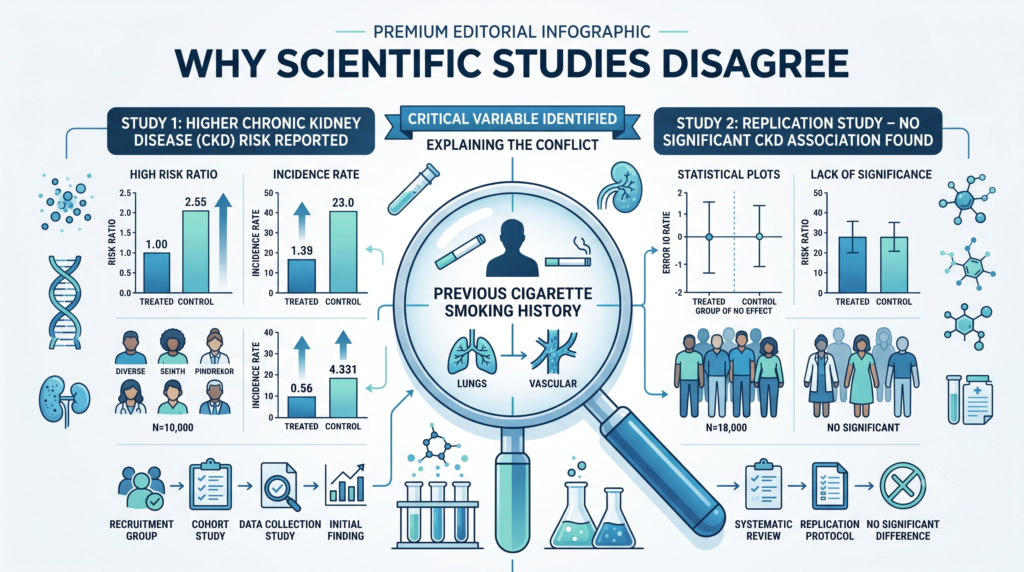
Seven weeks later, a different research team published a replication attempt using the same NHANES years. It is posted as a preprint, meaning it has not yet been through formal peer review, which matters for how much weight to put on it. Using a larger retained sample (7,139 participants versus the original study’s 872) and, critically, separating participants by their history of conventional cigarette smoking, the replication found no significant association between e-cigarette use and chronic kidney disease. The authors identified the likely reason for the original finding: heavy e-cigarette use in that dataset was heavily concentrated among former smokers (83%), and the original study never accounted for that. Once smoking history is properly separated out, the dramatic 2.5-fold risk disappears.
This is not a case of one study being right and one being wrong in some abstract sense. It is a demonstration of how a single analytical choice, whether to separate current, former, and never-smokers before comparing vapers to non-vapers, can produce a headline-grabbing number or a null result from the exact same underlying data.
What the Closest Real Evidence, on Smoking, Actually Shows
Because no study measures vaping and kidney stones together, the nearest available evidence comes from cigarette smoking research, which has been studied for decades. It should be read as an analog, not a substitute. Nicotine delivery is similar, but combustion products are not, and vaping and smoking are chemically different exposures.
The NHANES-based study covered above found current smokers had 17% higher odds of kidney stones. A separate 2022 meta-analysis in Frontiers in Public Health, pooling five earlier observational studies involving over 20,000 people, found something that does not fully agree with it: ever-smokers had 31% higher odds and ex-smokers had 73% higher odds, both statistically significant, but current smokers showed no significant increase at all, an odds ratio of just 1.08, with a confidence interval (0.94 to 1.23) that crossed 1.0.
Put those two findings side by side and there is a genuine tension: one study finds the risk concentrated in current smokers, the other finds it concentrated in former and ever-smokers, with current smokers showing no clear signal. That is not a contradiction to paper over. It is a sign that even the closest available analog to a vaping-stones link is still being worked out, not settled science with a single clean number attached to it.
The proposed mechanisms for why smoking might raise stone risk are more consistent across the literature: cadmium and lead, both present in tobacco smoke, have been detected directly in the mineral composition of kidney stones from smokers, according to 2023 lab analysis in the Journal of Applied Laboratory Medicine; nicotine may raise levels of a hormone called vasopressin, which reduces urine output and lets minerals concentrate; and oxidative stress from smoke exposure may damage the kidney’s filtering tubules in a way that helps mineral crystals stick and grow. None of these mechanism studies were conducted on vapers.
The Proposed Mechanisms, and How Much Evidence Backs Each One
Most articles on this topic list the same handful of possible mechanisms with the same confident tone, regardless of how much evidence actually supports each one. Nicotine itself, and how it moves through the body, is covered in more depth in this guide to nicotine in vape products. Here is what backs each kidney-specific mechanism claim, and at what level.
| Proposed mechanism | Strongest evidence available | What it actually shows |
|---|---|---|
| Dehydration from vaping | No direct human study found | Plausible in theory (any behavior that reduces fluid intake could concentrate urine), but no study measured vapers’ hydration status or urine concentration directly |
| Nicotine-driven vasoconstriction reducing kidney blood flow | Human trial (Lyytinen 2023, n=22) plus animal studies | Nicotine aerosol measurably raised blood pressure and impaired blood vessel function in a small human trial; mouse studies link nicotine vapor to reduced filtration rate over months of exposure |
| Heavy metals from heating coils (nickel, tin, lead) | Human observational studies plus tobacco-smoke stone-composition data | Metal exposure markers are elevated in vapers’ urine (Sakamaki-Ching 2020); metals are detectable in the stones of smokers specifically, not vapers |
| Oxidative stress and cell damage | Multiple human studies, consistent | Fairly well replicated across the human studies in the 2025 systematic review. The most consistently supported mechanism of the group |
| Propylene glycol metabolizing into lactic acid | Animal toxicology data, high-dose only | Real chemistry: the kidneys clear about 45% of absorbed propylene glycol unchanged, and the liver converts the rest partly to lactic acid. But the toxicity data comes from doses far above realistic vaping exposure: a 2018 National Academies report found no kidney effects in two-year animal studies at 1,225 to 2,450 mg/kg/day, with a signal only appearing at 5,000 mg/kg/day |
One correction worth making explicitly, since it is an easy mix-up: propylene glycol is not the same compound as ethylene glycol, the toxic ingredient in antifreeze that is a well-documented cause of kidney damage and stone formation. Researchers studying propylene glycol’s safety have specifically had to distinguish the two because of how similar the names sound, and the National Academies report notes this directly. They behave very differently in the body. Both compounds are covered in more detail, including how to avoid one or the other, in this guide to making vape juice without PG or VG.
Vegetable glycerin, the other main e-liquid base, is partly processed by the kidneys as well. One animal study found kidney tubule calcification in 3 of 5 rats given a very high dose, 3,335 mg per kilogram of body weight per day, in their drinking water for six months. That is an extreme dose with no established equivalent in realistic vaping use, so it is worth knowing about without treating it as evidence of risk at normal exposure levels.
What Actually Lowers Kidney Stone Risk, Vaping or Not
Given the actual state of the evidence, there is no basis to say vaping is a proven cause of kidney stones, and no basis to say it is ruled out either. What is known with more confidence is what generally lowers kidney stone risk, regardless of vaping status, and it applies here the same as it would to anyone else.
Drinking enough water to keep urine pale instead of concentrated is the single most consistently supported prevention measure across the general kidney-stone literature. Limiting sodium intake matters because high salt intake increases calcium in the urine, one of the main minerals stones are made from. Getting a normal amount of dietary calcium, not too little, also helps, since very low calcium intake can paradoxically increase oxalate absorption and stone risk. People who already have risk factors (a personal or family history of stones, gout, diabetes, or high blood pressure) carry more background risk than the vaping question adds either way, and it is worth discussing that with a doctor regardless of vaping status. For the broader picture on what vaping is and is not known to do, the CDC guidance on the health effects of vaping is a reasonable starting point.
Anyone with symptoms that suggest a kidney stone (sharp pain in the back or side, pain during urination, or blood in the urine) should see a doctor before trying to sort out the cause.
Frequently Asked Questions
Does vaping definitely cause kidney stones?
No study has established that. The evidence that exists covers kidney function generally, not stone formation specifically, and even the function-related evidence is disputed.
Why do I keep seeing a 60% higher risk figure?
That number is repeated across several vaping-information sites but does not trace back to any study found in this research, including the most recent systematic review on the topic. The best-supported real figure, from smoking and nicotine-exposure research, not vaping directly, is closer to 17 to 25% higher odds.
Does propylene glycol turn into something that causes stones?
Propylene glycol does partly metabolize into lactic acid, but the toxicity data behind that concern comes from doses far higher than realistic vaping exposure produces. It is also a different compound from ethylene glycol, the antifreeze ingredient that is a genuine, well-documented cause of kidney damage. The similar names lead to some understandable confusion between the two.
Is nicotine-free vaping safer for kidney health?
In the one small human trial that tested this directly, nicotine-free aerosol did not produce the blood pressure or blood vessel effects that nicotine-containing aerosol did. That is a single small study, not a settled answer, but it points toward nicotine specifically being the more active variable in the mechanisms studied so far.
Does switching from smoking to vaping lower kidney stone risk?
There is no direct study comparing the two for kidney stone risk. The closest evidence, on smoking specifically, is mixed on which smoking status (current versus former) carries more risk, which makes a confident answer about switching impossible right now. Readers looking to reduce nicotine exposure generally, rather than switch from one nicotine product to another, may find this piece on using CBD vaping to quit nicotine more directly useful.
How This Article Was Researched
This article draws on peer-reviewed journal articles, NHANES survey data, a 2025 systematic review, a 2025 preprint (clearly labeled as such above), and the 2018 National Academies of Sciences, Engineering, and Medicine report on e-cigarettes, covering research published between 2017 and 2025. Several sources were excluded because they were paywalled or inaccessible at the time of research and could not be verified directly; none of their claims are repeated here. Because two studies central to this piece, the NHANES chronic-kidney-disease finding and its replication, are recent and, in one case, not yet peer-reviewed, this article should be rechecked as further research or a published version of the replication becomes available.

Alex is a vaping enthusiast with 6 years of hands-on experience across disposable vapes, pods, e-liquids, and flavors. He shares his reviews, insights, and practical tips on vaping with the PureVapeReviews community to help readers make better-informed choices.