
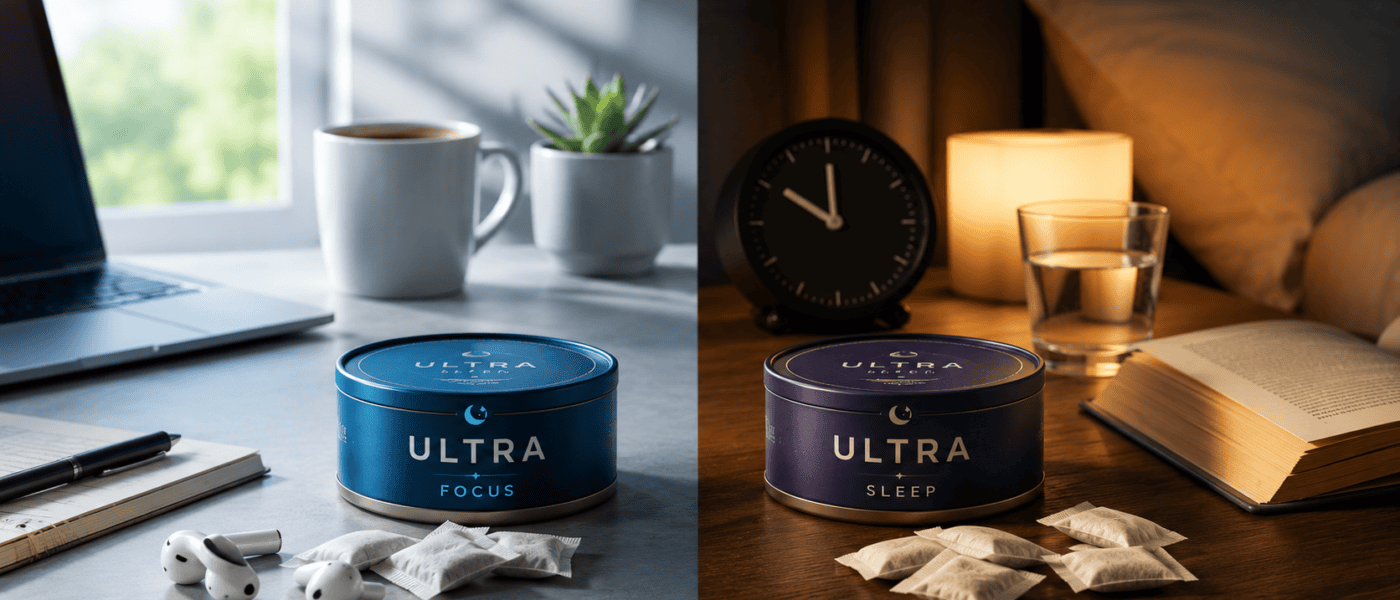
Ultra sells two pouches that look almost identical on the shelf: Focus and Sleep. Same brand, same tea-bag-style pouch you park under your lip, same price. The difference is what they do to you. Focus is built to wake your brain up, and Sleep is built to wind it down. Pick the wrong one, and you get a stimulant when you wanted rest. This guide on Ultra focus vs Ultra sleep pouches makes the choice simple, and it is built on each product’s real formula and the research behind it, not the brand’s marketing.
A quick note on method: this is an independent, evidence-based comparison. PureVapeReviews is not a pouch brand and was not paid by Ultra. Every fact below comes from Ultra’s published ingredient lists, the peer-reviewed studies on those ingredients, and the live product pricing.
The 10-Second Answer
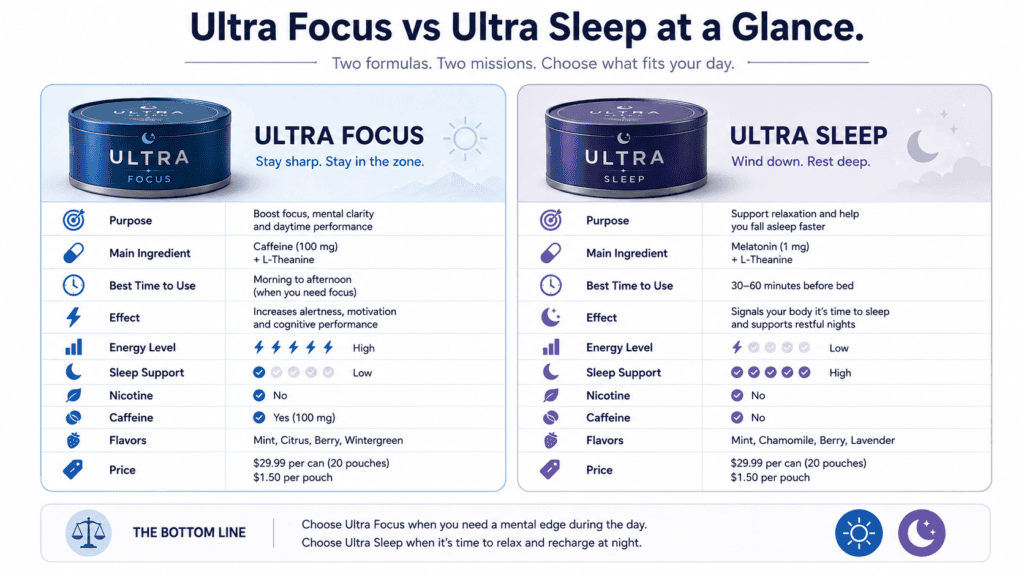
Buy Ultra Focus if your problem happens during the day: an afternoon slump, trouble concentrating, or wanting gym energy without caffeine or nicotine. Buy Ultra Sleep if your problem happens at night: lying awake, a restless mind, or wanting off high-dose melatonin gummies. These two are not rivals fighting for the same job. They are a daytime tool and a nighttime tool, and plenty of people who buy both use Focus by day and Sleep at night.
Ultra Focus vs Ultra Sleep Pouches: Side by Side Comparison
| Ultra Focus | Ultra Sleep | |
|---|---|---|
| Its job | Daytime energy and concentration | Nighttime wind-down |
| Main active | Paraxanthine (enfinity), 100 mg | Melatonin, 1 mg |
| Other ingredients | L-theanine, alpha-GPC, panax ginseng, B6, B12 (proprietary) | L-theanine 50 mg, magnesium 30 mg, lemon balm 12 mg, chamomile 10 mg, passionflower 10 mg |
| What you feel | Alert, focused, calm-but-awake | Relaxed, drowsy, ready for bed |
| When to use it | Morning through early afternoon | About 15 to 30 minutes before bed |
| Nicotine or caffeine | Neither | Neither |
| Flavor | Blue Razz, Wintergreen, Cool Mint, Tropical, Watermelon | Honey Lemon |
| Price | $16 per can (3/$48, 6/$96, 9/$144) | $16 per can (3/$48, 6/$96, 9/$144) |
| Best for | Focus without a coffee or a vape | A low-dose melatonin bedtime ritual |
Same Brand, Opposite Jobs
The whole comparison comes down to one question: what time of day do you have a problem? That is really the only thing separating these two products. Focus carries paraxanthine, a stimulant that promotes alertness. Sleep carries melatonin, the hormone that tells your brain bedtime is near. One pushes the gas, the other eases off it. Ultra even positions them this way itself, telling customers to use Focus during the day and reach for Sleep at night.
So the shopping decision is not really “which pouch is better.” It is “which problem are you trying to fix, and when.” Get that straight and the rest is easy.
What Each One Actually Does
Ultra Focus runs on paraxanthine, the compound your body naturally makes when it processes caffeine. It delivers caffeine-style alertness, and in Ultra’s case, with no actual caffeine and no nicotine. The honest catch, covered in full in the Ultra Pouches review, is dose: the main study on paraxanthine used 200 mg, while one Focus pouch has 100 mg, so a single pouch is half the studied amount and the brand suggests one to two at a time.
Ultra Sleep runs on 1 mg of melatonin plus five calming ingredients. Melatonin is a mild sleep aid, not a knockout drug. The largest pooled analysis found it helps people fall asleep about 7 minutes faster, so think gentle nudge rather than sedative. The upside is that 1 mg is a low, sensible dose, well under the 5 to 10 mg in many gummies, which the Ultra Sleep Pouches review breaks down in detail.
The Timing Trap Most Buyers Miss
Here is the point almost no shopper thinks about, and it is the most useful thing in this guide. A stimulant taken too late in the day does not just keep you awake. It can shift your body clock later. In a controlled study, a caffeine dose taken 3 hours before bed pushed the body’s melatonin rhythm back by about 40 minutes, roughly half the delay you would get from staring at bright light at bedtime (Burke and colleagues, Science Translational Medicine, 2015).
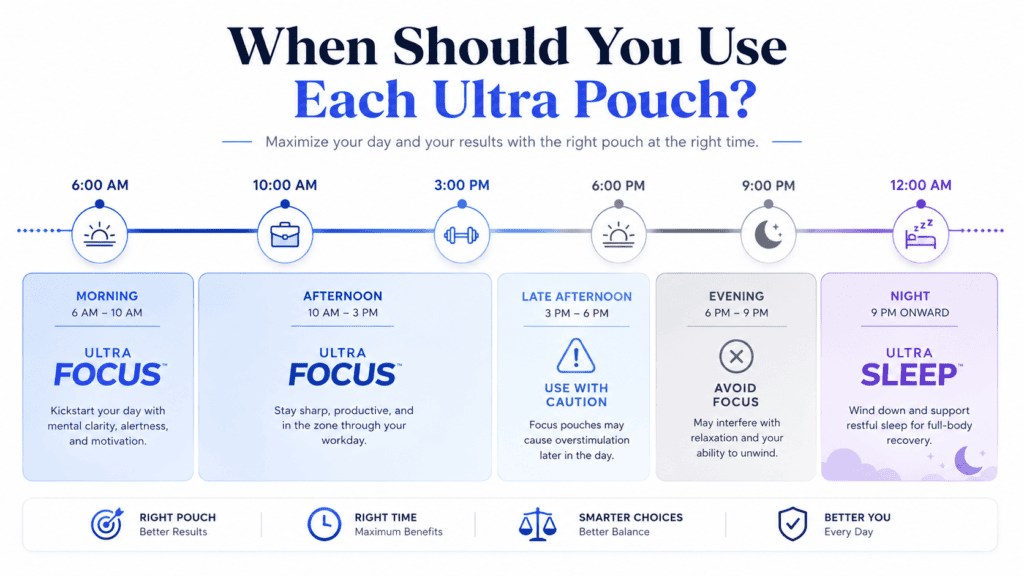
Paraxanthine works through the same brain pathway as caffeine, so a late Focus pouch can work directly against a Sleep pouch you take a few hours later. Ultra clears from the body faster than caffeine, which softens the effect, but the brand still tells users not to take Focus within 4 to 6 hours of bedtime. The practical rule: finish your last Focus pouch by early afternoon, and save Sleep for right before bed. Using Focus at 9 p.m. and then a Sleep pouch at 11 p.m. is fighting yourself.
Can You Use Both?
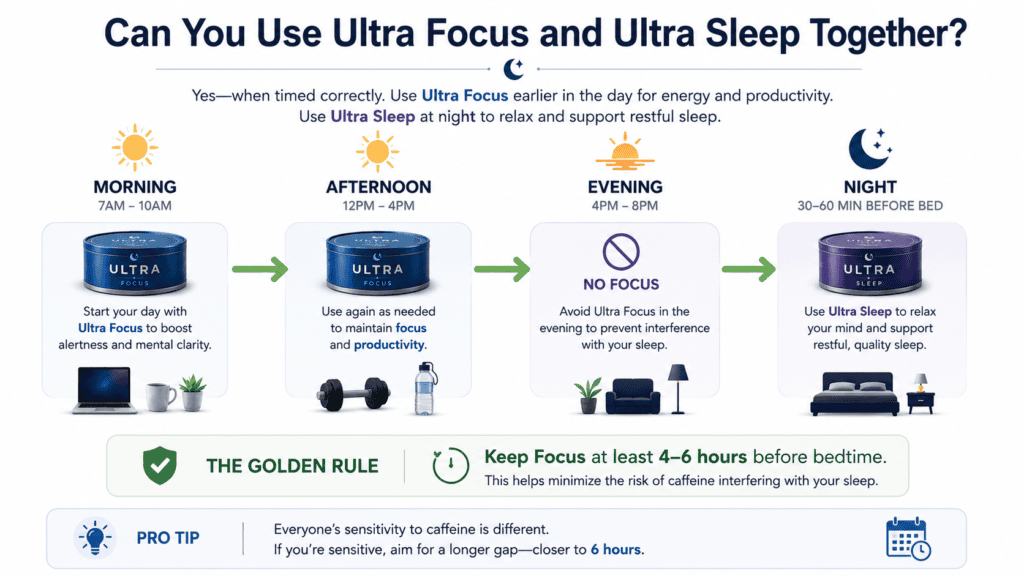
Yes, and for a lot of people that is the natural setup: Focus to get through the workday, Sleep to switch off at night; our how to use Ultra pouches guide covers placement and timing for each. Both are nicotine-free, tobacco-free, and not habit-forming, so there is no dependency risk in running a day-and-night routine. Two rules keep it sane. Stay under each product’s daily limit, since Ultra Caps Focus is at 4 pouches a day. And keep them far apart on the clock, with Focus ending in the early afternoon and Sleep saved for bedtime, so the stimulant has cleared before the melatonin has to work. If you take medication or have a health condition, check with a doctor first. This is general information, not medical advice.
Price and Value Are a Tie
There is no price angle here. Focus and Sleep cost the same: $16 per can, sold only in multi-packs starting at 3 cans for $48, which works out to about $1.07 per pouch either way; our where to buy Ultra pouches guide has the current packs. Both sit at the premium end of their categories, more than a coffee and far more than a bottle of plain melatonin. Because the pricing is identical, value comes down to one thing: does the product solve the problem you actually have? A Focus pouch is worth it to someone who needs daytime energy without caffeine, and wasted on someone who sleeps fine but lies awake worrying. Sleep is the reverse.
Which Should You Buy?
Match the pouch to the moment you struggle:
You hit an afternoon wall, need to lock in at work, or want clean energy before the gym without a stimulant crash: choose Focus.
You take too long to fall asleep, want to cut down from a strong melatonin gummy, or just want a calmer bedtime routine: choose Sleep.
You deal with both a groggy afternoon and a restless night: buy both and run them as a schedule, Focus early and Sleep late.
You want something to calm daytime anxiety: neither is a great fit. Sleep is designed for bedtime and will not help you function during the day, and Focus is a stimulant that could make anxiety worse.
The Verdict
There is no overall winner here, because Focus and Sleep are not in the same race. The right pick is decided entirely by the time of day you need help. If you want a purely quality-of-evidence read, Focus has the stronger science behind its active ingredient, since paraxanthine has real randomized trials. However, Ultra under-doses it against those trials. Sleep plays it safer with a sensible low melatonin dose but oversells how fast and how strongly it works. In the full reviews, both land at 3.5 out of 5: solid and honest, and both are sold at a premium price. Buy the one that fixes your actual problem, and skip the other until you need it.
Related reading
Can you use Ultra Focus and Ultra Sleep on the same day?
Yes. The common routine is Focus during the day and Sleep before bed. Keep them far apart on the clock, finish Focus by early afternoon, and stay under the 4-pouch daily limit for Focus so the stimulant has cleared before the melatonin needs to work.
Is Ultra Focus or Ultra Sleep better?
Neither is better in general, because they do opposite jobs. Focus is for daytime energy and concentration, and Sleep is for falling asleep at night. The better buy is whichever one matches the problem you are trying to solve.
Does Ultra Focus keep you awake at night?
It can if taken too late. Paraxanthine is a stimulant, and a stimulant close to bedtime can delay your body clock. Ultra recommends not using Focus within 4 to 6 hours of bed, so keep it to the earlier part of the day.
Do Ultra Focus or Ultra Sleep contain nicotine or caffeine?
Neither pouch contains nicotine, tobacco, or caffeine. Focus uses paraxanthine, a caffeine relative, for daytime energy, and Sleep uses melatonin plus calming herbs for nighttime.
Which one is better value for money?
They cost the same, at $16 per can and about $1.07 per pouch, so value depends only on fit. Whichever pouch solves your problem is the better value, and buying the one you do not need is money wasted.

Alex is a vaping enthusiast with 6 years of hands-on experience across disposable vapes, pods, e-liquids, and flavors. He shares his reviews, insights, and practical tips on vaping with the PureVapeReviews community to help readers make better-informed choices.
Related Posts
Where to Buy Ultra Pouches (Near Me): Every Real Option in 2026
If you searched “Ultra pouches near me” hoping to grab a can on the way home, here is…

Top 5 Ultra Pouches Flavors, Ranked by Real Reviews (2026)
Ultra focus pouches comes in five flavors, and picking the right one is the difference between a pouch…
How to Use Ultra Pouches Correctly: Steps and Timing
Most “how to use a pouch” advice online is written for nicotine pouches, so it only gets you…