Between 3.5 and 5 calories per millilitre. A 2ml disposable vape holds roughly 7 to 10 calories while a 10ml bottle holds 35 to 50.
The range exists because the United States and the European Union assign different calorie values to the main ingredient. Nobody has settled which applies to vape liquid, since vape liquid is not food. And none of it may matter, because inhaling something is not the same as eating it.
Let’s read this article on “How Many Calories Are in a Vape” by our team PureVapeReviews.com.
Calories in Vape: The Short Answer
E-liquid does contain calories, but the amount is small and depends on the blend. The calorie figures published online for a single puff in most of the articles are highly inaccurate. Most sites use a puff size that is physically impossible, and the section below shows the arithmetic.
Nobody has measured how much of it the body actually absorbs from inhaling. Sites claiming the answer is zero are guessing, in the same way sites treating it like food are guessing.
Where These Numbers Come From
E-liquids has mostly two prominent ingredients: vegetable glycerin, also called glycerol, and propylene glycol. Everything else is flavouring and nicotine, present in tiny amounts.
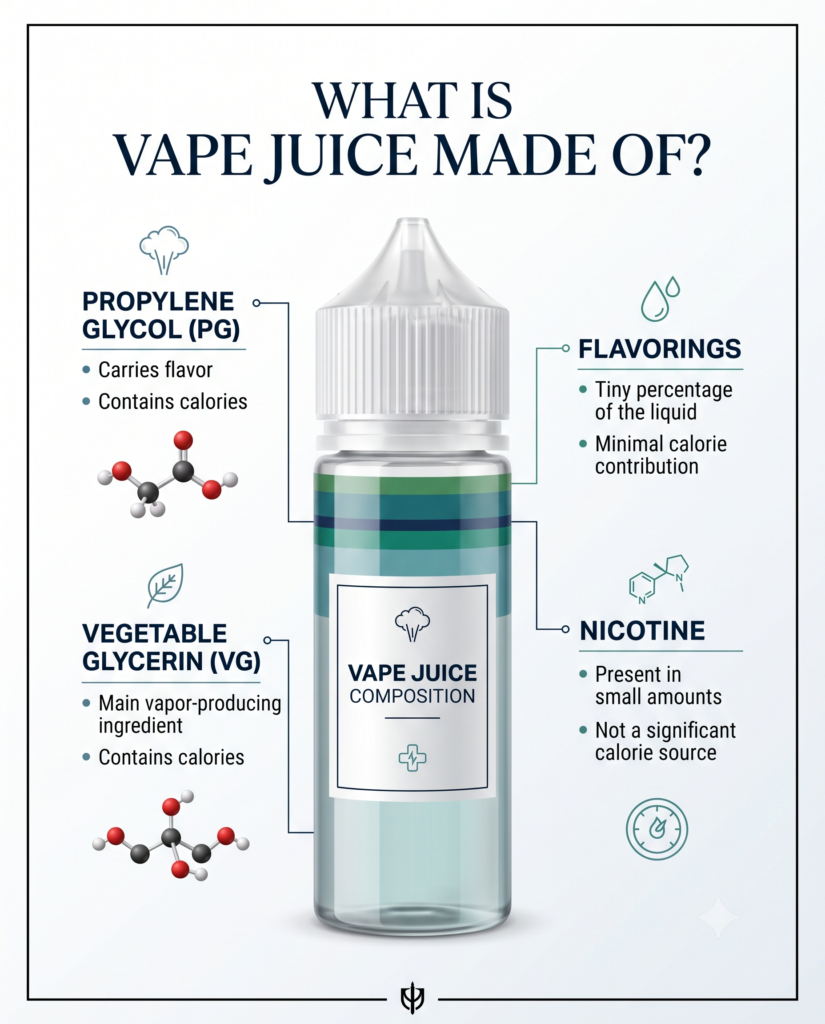
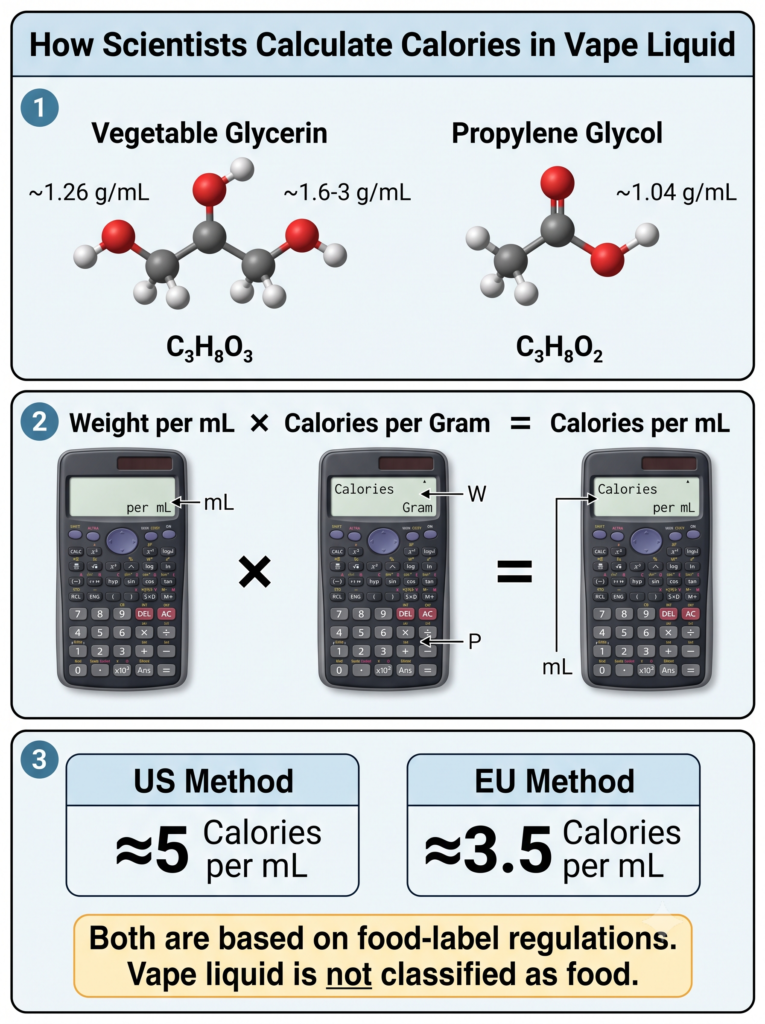
Both ingredients carry energy. To work out calories per millilitre, two figures are needed for each: how many calories per gram, and how much a millilitre weighs.
| Ingredients | Weight per ml | Calories per gram |
| Vegetable glycerin | 1.264 g | 4.32 (US) or 2.4 (EU) |
| Propylene glycol | 1.036 g | about 4.1 |
Multiply the two, and you get calories per millilitre. That is the entire calculation.
Why Glycerin has Two Numbers?
In the United States, the Food and Drug Administration counts glycerin within total carbohydrates, and the figure used across the US food industry is 4.32 calories per gram. In the European Union, Annex XIV of Regulation 1169/2011 sets the conversion factors for food labels. It lists polyols at 2.4 calories per gram. Glycerin is a polyol.
Glycerin and propylene glycol are not named individually anywhere in that EU table. Neither is vape liquid, because vape liquid is not a food and no labelling rule requires a calorie count on it.
So there is no single official answer. There is an American number and a European number, and they differ by a lot.
Curious readers can find more on what these two ingredients do in this look at PG and VG.
Calories Per Millilitre, Both Ways
Worked for a 60/40 VG/PG blend, the most common ratio in disposables.
| Basis | Calories per ml |
| US figures | 4.98 |
| EU figures | 3.52 |
Changing the VG/PG ratio barely moves it. Across every blend on the market, the swing is about one calorie per millilitre.
| Blend | US basis | EU basis |
| 70/30 VG/PG | 5.10 | 3.40 |
| 60/40 VG/PG | 4.98 | 3.52 |
| 50/50 VG/PG | 4.85 | 3.64 |
Calories by Device and Bottle Size
| Device or Bottle | Liquid | Calories |
| Standard 600-puff disposable | 2 ml | 7 to 10 |
| Small disposable | 5 ml | 18 to 25 |
| Bottle | 10 ml | 35 to 50 |
| Mid-size disposable | 12 ml | 42 to 60 |
| Large disposable | 20 ml | 70 to 100 |
| Bottle | 30 ml | 106 to 149 |
| Bottle | 60 ml | 211 to 299 |
| Shortfill | 100 ml | 352 to 498 |
A whole 600-puff disposable carries less energy than a single cracker. A 100ml shortfill, if someone drank it, would sit somewhere near a small meal. Nobody drinks it.
How long a given amount lasts varies by device and habit, covered in this article by our team how long vape juice lasts.
Calories Per Puff, and Why the Published Numbers are Wrong?
This is where the internet falls apart.
Most articles on this question say a puff uses 0.05ml of liquid, which works out to about 0.25 calories per puff. That figure appears across the first page of Google.
It cannot be right. Here is the check:
0.05 ml × 600 puffs = 30 ml
A 600-puff disposable holds 2 ml.
The number is out by a factor of fifteen. A device using 0.05ml per puff would drain a standard disposable in about forty puffs.
Work it from the manufacturer’s own rating instead. Divide the liquid by the puffs it claims to deliver.
| Device | Liquid ÷ puffs | Ml per puff | Calories per puff |
| 2 ml, 600 puffs | 2 ÷ 600 | 0.0033 | 0.012 to 0.017 |
| 5 ml, 2,000 puffs | 5 ÷ 2,000 | 0.0025 | 0.009 to 0.012 |
| 12 ml, 5,000 puffs | 12 ÷ 5,000 | 0.0024 | 0.008 to 0.012 |
| 20 ml, 20,000 puffs | 20 ÷ 20,000 | 0.0010 | 0.004 to 0.005 |
A puff carries somewhere between 0.004 and 0.017 calories. That works out to roughly 60 to 250 puffs per single calorie.
This also explains why published figures range from 0.01 to 0.25 calories per puff. Different sites assume different puff sizes, and the larger assumptions do not survive contact with the arithmetic.
One caveat. Rated puff counts come from manufacturers and are measured in lab conditions, so real-world counts usually run lower. That pushes calories per puff slightly higher, but nowhere near 0.25. Actual puff counts are discussed further in how many puffs are in a disposable.
Do Inhaled Calories Even Count?
A calorie measures energy the body can pull out of something. Every food calorie figure assumes the thing gets swallowed, digested, and absorbed through the gut.
Vape aerosol does not go that route. It goes into the lungs, and a large share of it comes straight back out on the exhale.
Some does cross into the bloodstream. That is how nicotine reaches the brain within seconds. So the confident claim that vaping delivers zero calories is an assumption too, just pointing the opposite way from the sites that treat e-liquid like a drink.
No study has measured how much energy the body actually takes up from inhaled glycerin or propylene glycol. Until one does, the honest position is that the amount is small enough to be unlikely to matter, and anyone quoting a precise absorbed figure is inventing it.
Is there Sugar in Vape Juice?
No. Sugar is not used in e-liquid, and there is a practical reason. Sugar caramelises and burns on a hot coil, which ruins the taste and clogs the device.
Sweet flavours come from sweeteners such as sucralose and ethyl maltol, used in very small quantities. These do not carry meaningful calories at the amounts involved.
This also means vaping is unlikely to spike blood sugar through sugar content, because there is no sugar to spike it. Nicotine has its own effects on insulin and glucose handling, which is a separate question worth asking a doctor about for anyone managing diabetes.
Readers checking labels for other reasons may also want this note on gluten and vape products.
The Question Underneath: Does Vaping Affect Body Weight?
Most people asking about vape calories are really asking whether vaping will make them gain or lose weight. That question has actual research behind it, and none of the pages currently ranking for vape calories mention any of it.
What Nicotine Actually Does?
| Finding | Evidence |
| Nicotine lowers body weight through reduced appetite and higher energy use, both at rest and during activity | Meta-analysis of 65 clinical studies, Schwartz and Bellissimo, 2021 |
| The mechanism involves reduced hunger signalling in the brain, more physical movement, and more heat production in brown fat | Martínez de Morentin and colleagues, 2012 |
| Average weight gain after quitting cigarettes | 9 pounds, meta-analysis of 35 cohort studies, Tian and colleagues, 2015 |
So the appetite effect is real, and it comes from the nicotine rather than the calories in the liquid. Nicotine strength varies widely between products, as covered in this guide to nicotine levels.
The First Study on Vaping and Body Weight
In June 2025, researchers published a working paper through the National Bureau of Economic Research examining what happened to body weight when US states raised taxes on vaping products. The authors describe it as the first study to look at this.
| Result | Finding |
| $1 per ml tax rise, female teenagers | Obesity probability fell 0.8 to 1.0 percentage points |
| Same group, body weight | Fell 1 to 2 pounds |
| Male teenagers and adults | Effects too small to separate from zero |
| Evidence that cutting vaping caused weight gain | None found |
The reasons were indirect. Teens in higher-tax states drank less alcohol, used less marijuana, and ate more vegetables. Among adults, the researchers saw less drinking and fewer french fries. The authors also flagged a worrying side effect: some teens switched to regular cigarettes.
Two things readers should weigh. This is a working paper and has not been through peer review. It was funded by Global Action to End Smoking, formerly the Foundation for a Smoke-Free World, an organisation whose funding agreement with Philip Morris Global Services ended in September 2023. One author’s research centre has received Charles Koch Foundation funding. All of that is disclosed in the paper itself.
Weight is one of several body changes people ask about with vaping. Another common one is covered in does vaping affect breast size.
What Happens to Weight When People Stop Vaping?
| Fact | Figure |
| Average weight gain after quitting smoking | 6 to 10 pounds |
| Share who gain 25 to 30 pounds | About 1 in 10 |
| When most of the gain happens | First 6 months |
| After that | Many people start losing it again |
| Heart rate rise after a cigarette | 10 to 20 extra beats per minute |
| Share of daily calories spent keeping the body running | About 70% |
Half of people gain less than the average. And six months after quitting, most have already lost some of what they gained.
The health guidance on this is consistent: staying off cigarettes matters far more than a few pounds.
How many calories are in one puff of a vape?
Between 0.004 and 0.017 calories, depending on the device. That is roughly 60 to 250 puffs to reach a single calorie.
How many calories are in a 600 puff vape?
A 600-puff device holds 2ml, which works out to 7 to 10 calories in the liquid. How much of that a person absorbs has never been measured.
Do you gain weight from vaping?
No study has shown vaping causes weight gain. The calories in the liquid are far too few to matter. Nicotine tends to suppress appetite, which, if anything, pushes the other way.
Does vaping burn calories?
Nicotine raises metabolic rate slightly, which is why people often gain weight after quitting. That is an effect of the drug, not of vaping itself, and it is not a sensible weight-control method.
Does vape juice contain sugar?
No. Sweeteners such as sucralose are used because sugar burns on a coil.
Do vape calories break a fast?
No study has looked at this. The amounts are tiny, and it is unclear how much is absorbed at all. Anyone fasting for medical reasons should ask their doctor.
How do vape calories compare to a cigarette?
Cigarettes contain no meaningful calories either. Neither product is a source of energy in any practical sense.
Is 200 puffs a day a lot?
It is roughly a third of a standard 600-puff disposable, so about 2 to 3 calories worth of liquid. The nicotine intake matters far more than the calories.
Frequently Asked Questions
How many calories are in one puff of a vape?
Between 0.004 and 0.017 calories, depending on the device. That is roughly 60 to 250 puffs to reach a single calorie.
How many calories are in a 600 puff vape?
A 600-puff device holds 2ml, which works out to 7 to 10 calories in the liquid. How much of that a person absorbs has never been measured.
Do you gain weight from vaping?
No study has shown vaping causes weight gain. The calories in the liquid are far too few to matter. Nicotine tends to suppress appetite, which if anything pushes the other way.
Does vaping burn calories?
Nicotine raises metabolic rate slightly, which is why people often gain weight after quitting. That is an effect of the drug, not of vaping itself, and it is not a sensible weight-control method.
Does vape juice contain sugar?
No. Sweeteners such as sucralose are used because sugar burns on a coil.
Do vape calories break a fast?
No study has looked at this. The amounts are tiny, and it is unclear how much is absorbed at all. Anyone fasting for medical reasons should ask their doctor.
How do vape calories compare to a cigarette?
Cigarettes contain no meaningful calories either. Neither product is a source of energy in any practical sense.
Is 200 puffs a day a lot?
It is roughly a third of a standard 600-puff disposable, so about 2 to 3 calories worth of liquid. The nicotine intake matters far more than the calories.
How This Article Was Researched
PureVapeReviews does not test devices in a laboratory. The calorie figures here were calculated, not copied, and every input is listed so readers can repeat the working.
The calculation uses published densities for glycerin and propylene glycol, the US food-industry figure of 4.32 calories per gram for glycerin, the EU conversion factor of 2.4 calories per gram for polyols from Annex XIV of Regulation 1169/2011, and about 4.1 calories per gram for propylene glycol. Per-puff figures come from dividing rated liquid capacity by manufacturer puff ratings.
Weight and metabolism sections draw on two meta-analyses covering 65 and 35 studies, and a 2025 working paper from the National Bureau of Economic Research.
No study measuring how much inhaled e-liquid the body absorbs was found. If one is published, this page will be updated.
Last checked: 28 July 2026

Alex is a vaping enthusiast with 6 years of hands-on experience across disposable vapes, pods, e-liquids, and flavors. He shares his reviews, insights, and practical tips on vaping with the PureVapeReviews community to help readers make better-informed choices.