By Dr. Aishwarya Negi, BDS · Last updated July 26, 2026
No. Doctors have written up roughly 250 case reports on vaping-related harm since 2010. Not one of them describes vaping causing tonsillitis or tonsil stones. The only tonsil case in that whole collection points the other way, describing a patient whose long-running tonsillitis cleared up after he took up vaping.
Vaping can still hurt a throat. It just does not seem to hurt the tonsils.
Can Vaping Affect Tonsils: The short answer
Three things are worth separating, because people searching this question tend to mix them together.
- Vaping has not been shown to cause tonsillitis. No published case links the two.
- Vaping has not been shown to cause tonsil stones. No study has ever compared how often vapers and non-vapers get them.
- Vaping is linked to sore, dry, irritated throats. In a small number of published cases it has been tied to problems that are more serious than tonsillitis, and none of those problems involved the tonsils.
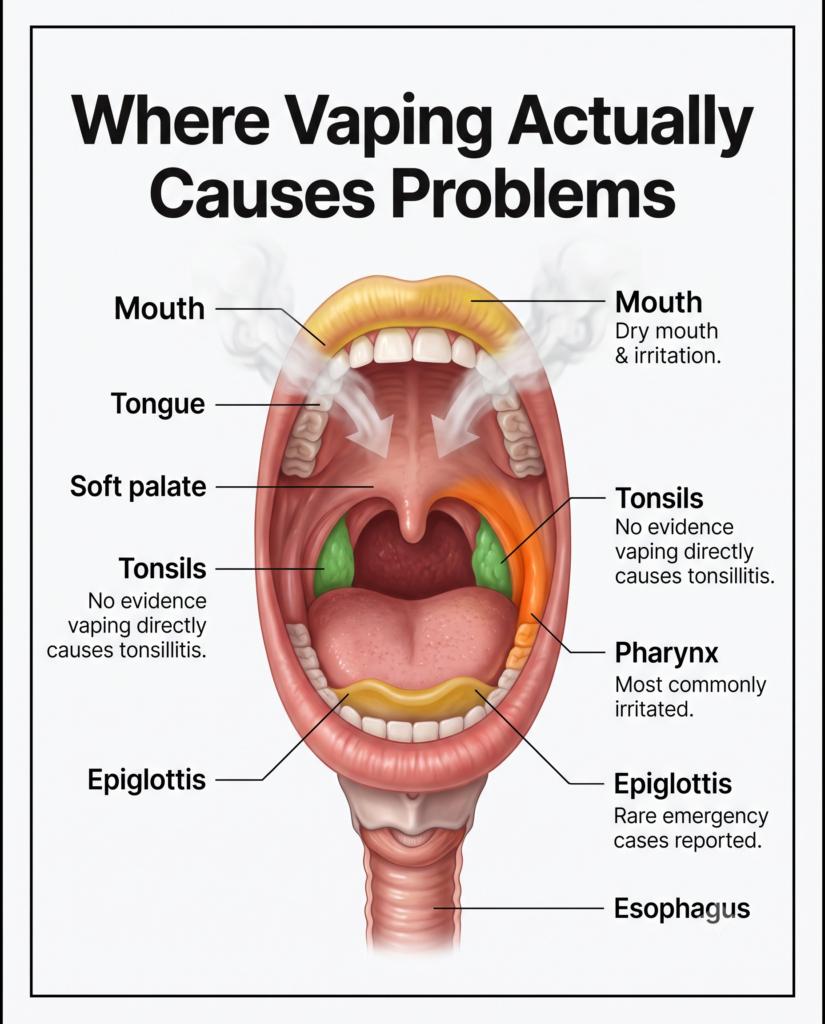
That last point is the useful one. A vaper with a painful throat is looking at a real issue. It is probably somewhere else in the throat.
What Doctors have Actually Published?
Cancer Council Victoria keeps a running collection of case reports where a doctor believed vaping played a part. It sits inside Tobacco in Australia: Facts and Issues, and the team built it by searching medical journals every month since 2015 for any paper with “vaping” or “e-cigarette” in the title, then filled in earlier years using PubMed. The version used here runs to the end of April 2024 and holds about 250 cases.
The collection exists to record harm. So it is a fair place to look for tonsil damage.
Searching the whole thing turns up this:
| Searched for | Times it appears |
|---|---|
| Tonsil | 1, in a case where tonsillitis improved |
| Epiglottitis | 0 |
| Oral thrush | 0 |
Fourteen years of collected harm reports contain no case of vaping causing a tonsil problem.
Here is every published case that touches the throat or mouth in a relevant way:
| Year | Patient | What doctors found | Tonsils | Outcome |
|---|---|---|---|---|
| 2017 | Non-smoker who started vaping | Long-running tonsillitis cleared | Improved | Resolved |
| 2018 | Never-smoker on low-nicotine liquid | Long-running nasal staph infection cleared | Not reported | Resolved |
| 2021 | 18-year-old, three months of daily vaping | Severe oral thrush, with white patches that wiped off | Not swollen | Cleared in two weeks |
| 2023 | 29-year-old, daily vaping | Swollen epiglottis blocking part of the airway, strep test negative | Not reported | Cleared in two weeks |
| 2025 | 23-year-old, heavy daily vaping | Red, inflamed back wall of the throat | Not the problem | Cleared a month after quitting |
| — | Teenager, daily vaping | Erosive esophagitis, with painful swallowing | Not reported | Treated |
| — | Child | Swollen epiglottis, no infection found | Not reported | Treated |
What this does not prove?
The people who built that collection make a point worth repeating. Most doctors never write up the cases they see. Published reports capture a tiny slice of what actually happens in clinics, and they tend to appear only when something looks new. So no published cases is not the same as no cases.
The two reports where symptoms improved also share a limitation. Both came from the same pair of researchers, and one appeared in a journal meant for early hypotheses. The 2017 tonsillitis case should not be read as evidence that vaping treats anything, and its authors do not claim it does.
Dentists often notice mouth changes before anyone else does, which is why what a dentist can see when you vape is worth knowing about.
Tonsil Stones are far more Common than People Realise
Most articles on this topic treat a tonsil stone as an odd event that needs explaining. The scan data says otherwise.
| How doctors looked | People scanned | Had tonsil stones |
|---|---|---|
| CT scan | 2,873 | 39.9% |
| CT scan | 482 | 46.1% |
| Dental X-ray | 1,042 | 17% to 19% |
The largest of these looked at nearly 3,000 consecutive patients and found tonsil stones in about four out of every ten, as published in The Scientific World Journal.
The lower figures come from dental X-rays, which miss most small stones. So the gap between studies is about the type of scan, not about different groups of people.
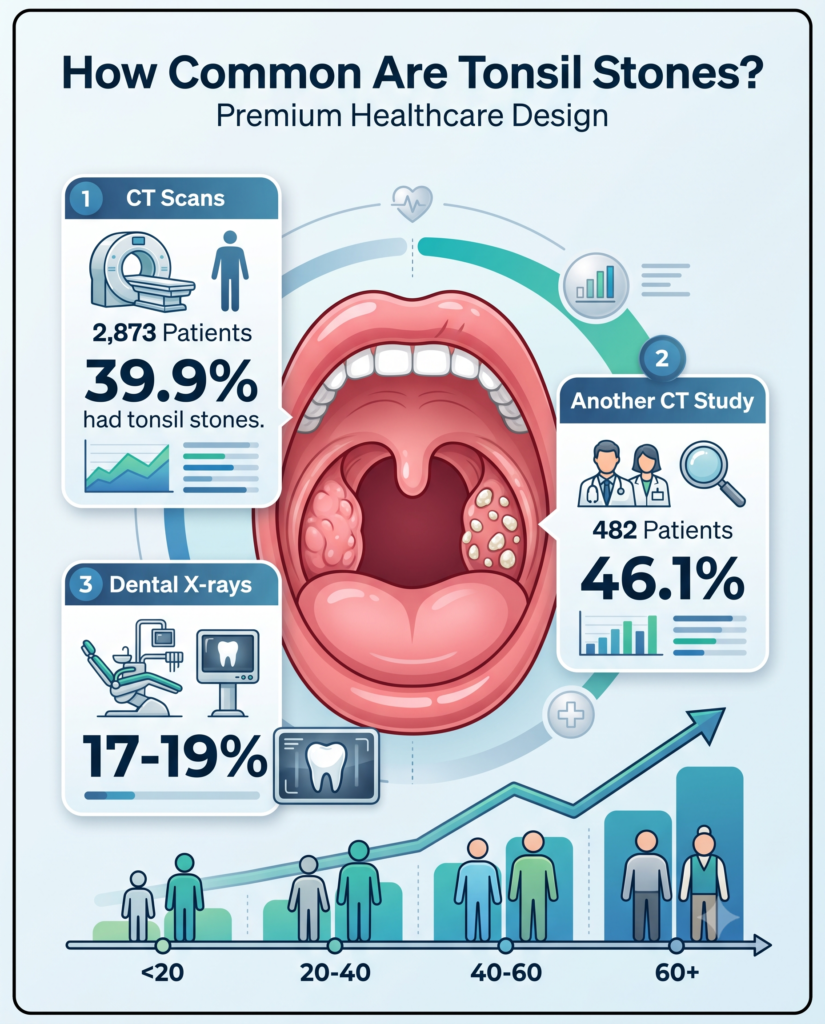
Tonsil stones also become more common with age. They peak in people between 50 and 69.
Put those numbers together, and a pattern shows up. Roughly four in ten adults are walking around with tonsil stones. Someone who starts vaping, then spots a white lump at the back of the throat, has found something that was already likely to be there.
No research team has ever compared tonsil stone rates between vapers and non-vapers. Until one does, any claim that vaping causes them is guesswork. And any real effect would have to be strong enough to show up against a background where four in ten people already have them.
What Vaping does do to the Throat?
None of this means vape aerosol is gentle. It is not.
1. Dry mouth, with a number that surprises people
A review of 14 studies covering 6,827 people looked at how often dry mouth gets reported. The results, published in Tobacco Induced Diseases, split like this:
| Group | Reported dry mouth |
|---|---|
| People who vape | 33% |
| People who smoke cigarettes | 24% |
Vapers report dry mouth more often than smokers do. That runs against the common assumption that vaping is easier on the mouth.
Propylene glycol, one of the main ingredients in vape liquid, pulls in moisture. That may be part of why the mouth dries out.
Dryness matters here for a specific reason. Saliva rinses debris out of the small pockets in the tonsil surface, and those pockets are where tonsil stones form. Less saliva may mean more debris stays put. That is a plausible chain, and it is worth saying clearly that no study has followed it through to actual stones.
2. Throat Irritation
Sore and scratchy throats are among the most commonly reported effects of vaping. Pooled figures land around 24%, but the range across individual studies runs from 4% to 69%. That spread is too wide to treat 24% as a firm number. Common is the honest description.
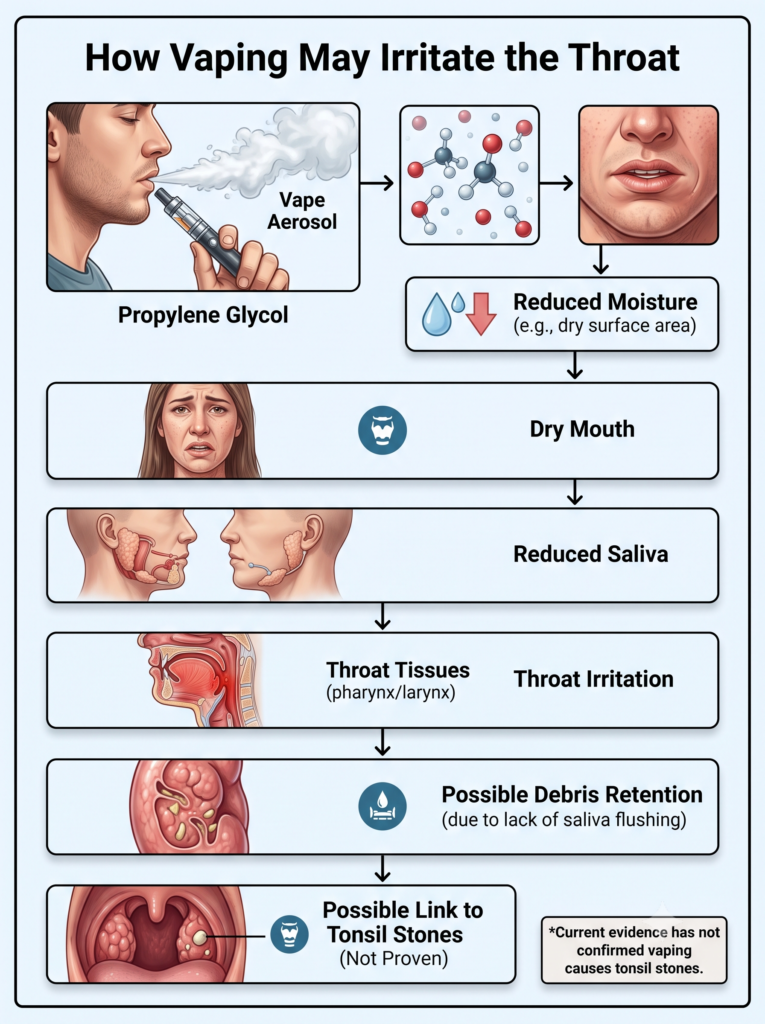
The aerosol carries several things known to irritate tissue, including propylene glycol, acrolein, formaldehyde, acetaldehyde, diacetyl, and traces of metals such as nickel and chromium.
3. Bacteria in the mouth shift
Researchers at NYU found that vapers carry a different mix of mouth bacteria than non-vapers, including higher levels of species tied to gum disease. Lab work has also shown vape aerosol helping Candida, the fungus behind oral thrush, grow more readily.
More of this shows up across the mouth than most people expect, which is covered in more depth in how vaping affects oral health and in what vaping does to tooth colour.
If it is not tonsillitis, What is it?
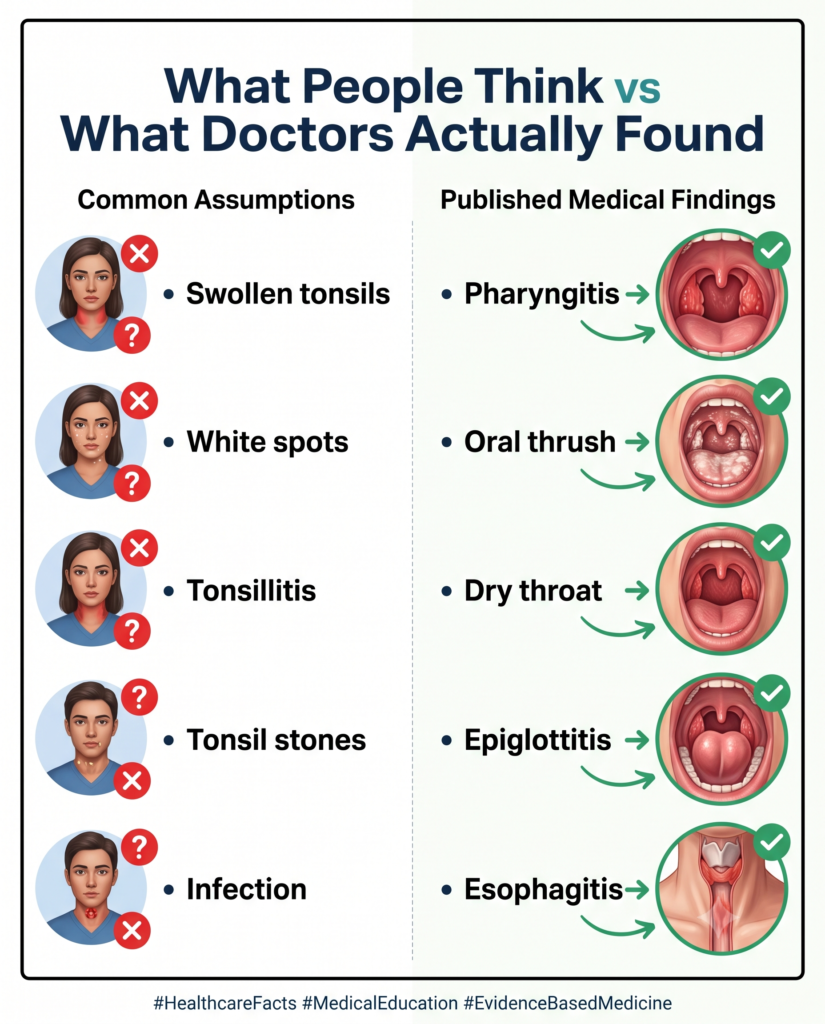
This is the part worth reading twice. When vaping has caused a throat problem serious enough for a doctor to publish, the diagnosis has never been tonsillitis.
| What people assume | What doctors actually recorded |
|---|---|
| Swollen tonsils | Pharyngitis. The back wall of the throat was inflamed, not the tonsils |
| White spots on the tonsils | Oral thrush. In that case, the tonsils were examined and were normal |
| Bad sore throat with breathing trouble | A swollen epiglottis. This is an emergency |
| Painful swallowing | Erosive esophagitis, in one teenage case |
The white patches question deserves a direct answer, because plenty of people search for it. In the one published case of a vaper with white patches in the mouth, the diagnosis was thrush. The doctors checked the tonsils and noted they were not swollen. That distinction changes treatment, since thrush needs antifungal medicine and antibiotics will not touch it.
The 2025 pharyngitis case is worth a mention too. A 23-year-old went to the emergency room with what he described as painful bumps at the back of his throat. He tested negative for strep. He worried it might be something he had caught. What the oral medicine clinic found was an inflamed throat wall and a very heavy vaping habit. A month after stopping, the symptoms had gone.
The epiglottitis case sits at the other end of the scale. A 29-year-old with a daily vaping habit arrived at an emergency department struggling to breathe when lying down. A neck X-ray showed a thickened epiglottis, and his strep swab came back clear. He needed steroids and antibiotics, and recovered fully over two weeks. That report is published in the International Journal of Emergency Medicine.
Swollen glands in the neck often show up alongside a sore throat and get blamed on the tonsils too. That is covered separately in vaping and swollen glands.
When to See a Doctor?
Some of what appears above is genuinely dangerous. A swollen epiglottis can close an airway.
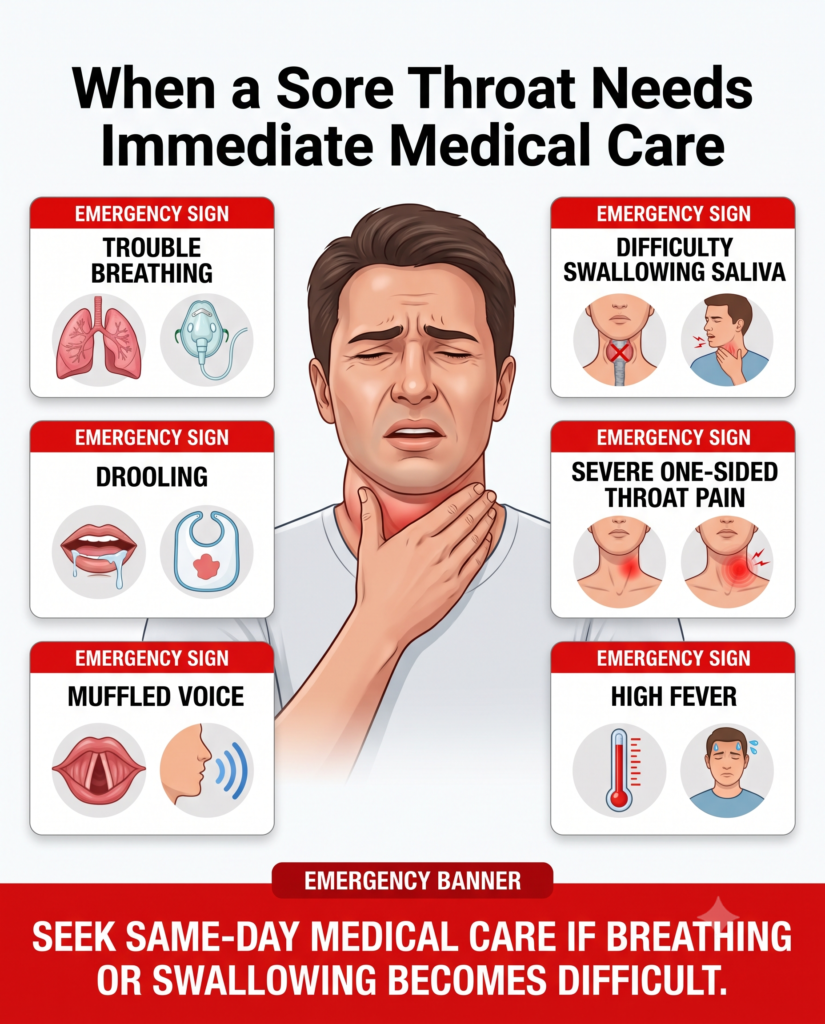
Get help the same day for:
- Trouble breathing, especially when lying flat
- Trouble swallowing saliva
- A muffled voice, as though speaking around something hot
- Drooling
- Severe pain on one side of the throat
Book an appointment within a few days for:
- Fever above 101.3°F, or 38.5°C
- White patches that will not wipe away
- A sore throat lasting more than a week
- Throat infections several times a year
Anyone already dealing with a dental problem should also read what to do about vaping after a root canal before lighting up again.
How to Reduce Throat Irritation if You keep Vaping?
None of this is a cure. It is what the published advice and case outcomes point toward.
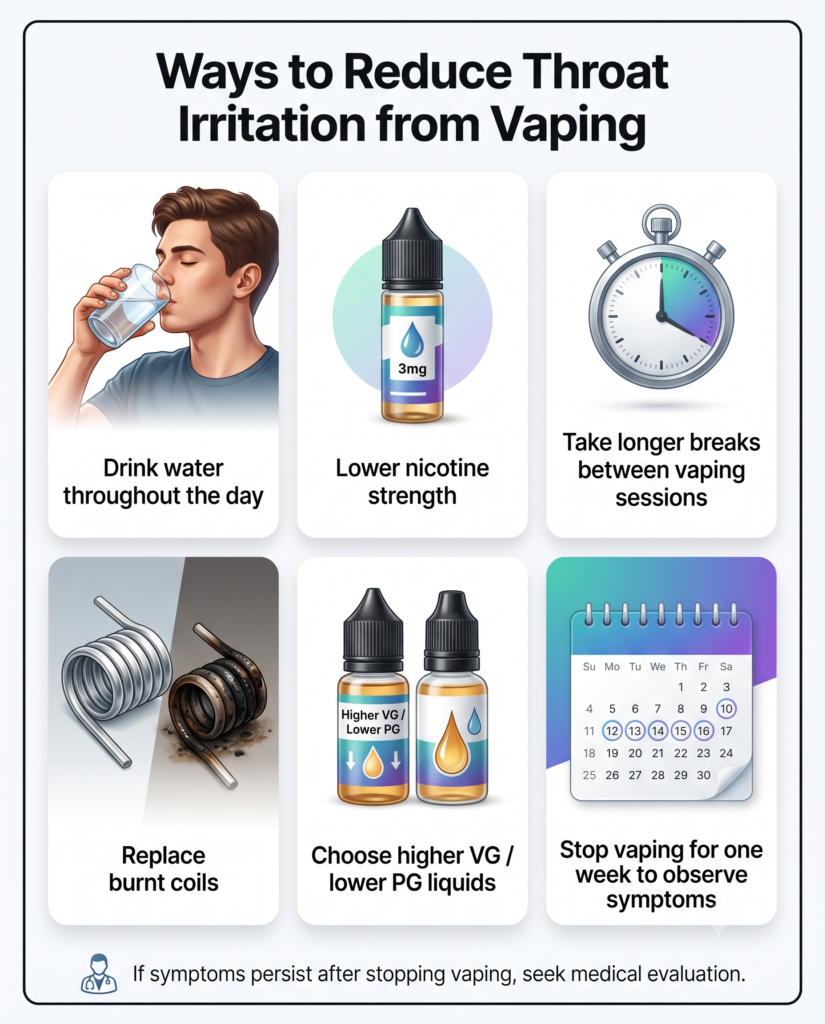
- Sip water throughout the day instead of gulping it occasionally
- Drop to a lower nicotine strength
- Leave gaps between sessions instead of vaping continuously
- Replace burnt coils as soon as the taste changes
- Try a liquid with more vegetable glycerine and less propylene glycol
- Keep brushing and flossing, and gargle with warm salt water
- Stop for a week and see what happens
That last one is the most informative thing a person can do. In the 2025 case, quitting cleared the problem entirely within a month. If symptoms fade after a break, irritation was the likely cause. If they do not, something else is going on and it needs looking at.
Coughing often travels with throat irritation, and technique matters as much as the liquid does. Reducing vape cough covers that, and nicotine strength explains how much of the harshness comes from the nicotine level itself.
Frequently Asked Questions
Can vaping make tonsillitis worse?
Probably, though no study has measured it directly. Vape aerosol irritates throat tissue, and tissue that is already inflamed tends to react more. Most doctors suggest stopping until the throat settles.
Can vaping cause white spots on the tonsils?
The one published case of a vaper with white patches turned out to be oral thrush, and the tonsils in that case were normal. White patches that do not wipe off should be looked at by a doctor either way.
Will quitting vaping get rid of tonsil stones?
There is no evidence either way, because no study has looked. Quitting may help with dry mouth, which could reduce debris build-up. That is reasoning, not proof.
Why do I suddenly get a lot of tonsil stones?
Common triggers include dry mouth, sinus problems, and changes in oral hygiene. Tonsil stones also become more common with age. A sudden increase is worth mentioning to a dentist or doctor.
Can tonsillitis spread through a shared vape?
Sharing any mouthpiece can pass on bacteria and viruses, including the ones that cause throat infections. The risk comes from sharing, not from vaping itself.
Can vaping cause a sore throat on one side?
Vaping tends to irritate the whole throat evenly. Pain on one side only is more typical of an infection or an abscess, and it should be checked.
How do you fix a swollen throat from vaping?
Stop vaping, drink water, and gargle with warm salt water. If swelling makes breathing or swallowing difficult, treat it as an emergency and get help the same day.
Does nicotine cause tonsillitis?
No evidence supports that. Nicotine can make the throat feel harsher at higher strengths, which is a different thing from an infection.

Dr. Aishwarya Negi is a practicing dentist based in Dehradun, India, and a clinician at Dental Peace Clinic. She writes and reviews PureVapeReviews content on how vaping and nicotine affect health, covering the mouth and throat as well as wider effects on the body.